
| Part of a series of articles about |
| Calculus |
|---|
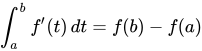
In mathematics, differential calculus is a subfield of calculus that studies the rates at which quantities change.[1]
The primary object of study in differential calculus is the derivative of a function, along with the less rigorous notion of differentials. The derivative of a function at a chosen input describes the rate of change of the function at that input. The process of finding a derivative is called differentiation. Geometrically, the derivative at a point is the slope of the tangent line to the graph of the function at that point, provided that the derivative exists and is defined at that point. For a real-valued function of a single real variable, the derivative of a function at a point generally determines the best linear approximation to the function at that point. Derivatives are frequently used to find the maxima and minima of a function, a significant application of the interior extremum theorem.
Differential calculus is one of the two traditional divisions of calculus, the other being integral calculus—the study of accumulation, the continuous analogue of summation. Differential calculus and integral calculus are connected by the fundamental theorem of calculus, which roughly states that differentiation is the reverse process of integration.
Derivatives have applications in nearly all quantitative disciplines. Almost all empirical models and physical laws concerning dynamical systems relate the time dependence and/or spatial variation of a quantity with its derivative with respect to time and/or spatial coordinates, using equations involving derivatives, called differential equations.
The notion of a derivative is made rigorous in real analysis. Almost all properties of derivatives that make them useful, and their behaviour intuitive and determinable, rely on the completeness of the real numbers; the results otherwise would be packed with cases so pathological that derivatives would be rendered almost useless, and the theory of differential equations non-existent. Derivatives and their generalizations appear in many fields of mathematics, such as complex analysis, functional analysis, differential geometry, measure theory, and abstract algebra.
Derivative
[edit]
The central idea of differential calculus is the derivative. For a real-valued function of one real variable, the derivative measures the instantaneous rate at which the value of the function changes with respect to its input. Geometrically, it is the slope of the tangent line to the graph of the function, when such a tangent line exists.[2]
If y = f(x), the derivative of f at x is commonly denoted by f′(x) or by dy/dx. It is defined by the limit

provided that this limit exists.[3] The quotient inside the limit is the slope of a secant line through two nearby points on the graph. As h approaches zero, the secant line approaches the tangent line, if the limiting slope exists.
For example, if f(x) = x2, then f′(x) = 2x. Thus the slope of the parabola y = x2 at x = 2 is 4.
Many derivatives can be found using general rules rather than directly from the limit definition. These include the sum rule, product rule, quotient rule, and chain rule. The power rule, for instance, gives
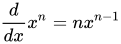
for positive integers n, and more generally in settings where the expression is defined.
The derivative also gives the best linear approximation to a differentiable function near a point. In this sense, differentiation is closely related to the differential. For functions of several variables, analogous ideas lead to partial derivatives, directional derivatives, and the total derivative.
History of differentiation
[edit]The concept of a derivative in the sense of a tangent line is a very old one, familiar to ancient Greek mathematicians such as Euclid (c. 300 BC), Archimedes (c. 287–212 BC), and Apollonius of Perga (c. 262–190 BC).[4] Archimedes also made use of indivisibles, although these were primarily used to study areas and volumes rather than derivatives and tangents (see The Method of Mechanical Theorems). The use of infinitesimals to compute rates of change was developed significantly by Bhāskara II (1114–1185); indeed, it has been argued[5] that many of the key notions of differential calculus can be found in his work, such as "Rolle's theorem".[6]
The mathematician, Sharaf al-Dīn al-Tūsī (1135–1213), in his Treatise on Equations, established conditions for some cubic equations to have solutions, by finding the maxima of appropriate cubic polynomials. He obtained, for example, that the maximum (for positive x) of the cubic ax2 – x3 occurs when x = 2a / 3, and concluded therefrom that the equation ax2 = x3 + c has exactly one positive solution when c = 4a3 / 27, and two positive solutions whenever 0 < c < 4a3 / 27.[7] The historian of science, Roshdi Rashed,[8] has argued that al-Tūsī must have used the derivative of the cubic to obtain this result. Rashed's conclusion has been contested by other scholars, however, who argue that he could have obtained the result by other methods which do not require the derivative of the function to be known.[9]
The modern development of calculus is usually credited to Isaac Newton (1643–1727) and Gottfried Wilhelm Leibniz (1646–1716), who provided independent[a] and unified approaches to differentiation and derivatives. The key insight, however, that earned them this credit, was the fundamental theorem of calculus relating differentiation and integration: this rendered obsolete most previous methods for computing areas and volumes.[b] For their ideas on derivatives, both Newton and Leibniz built on significant earlier work by mathematicians such as Pierre de Fermat (1607–1665), Isaac Barrow (1630–1677), René Descartes (1596–1650), Christiaan Huygens (1629–1695), Blaise Pascal (1623–1662) and John Wallis (1616–1703). Regarding Fermat's influence, Newton once wrote in a letter that "I had the hint of this method [of fluxions] from Fermat's way of drawing tangents, and by applying it to abstract equations, directly and invertedly, I made it general."[10] Isaac Barrow is generally given credit for the early development of the derivative.[11] Nevertheless, Newton and Leibniz remain key figures in the history of differentiation, not least because Newton was the first to apply differentiation to theoretical physics, while Leibniz systematically developed much of the notation still used today.
Since the 17th century many mathematicians have contributed to the theory of differentiation. In the 19th century, calculus was put on a much more rigorous footing by mathematicians such as Augustin Louis Cauchy (1789–1857), Bernhard Riemann (1826–1866), and Karl Weierstrass (1815–1897). It was also during this period that the differentiation was generalized to Euclidean space and the complex plane.
The 20th century brought two major steps towards our present understanding and practice of derivation : Lebesgue integration, besides extending integral calculus to many more functions, clarified the relation between derivation and integration with the notion of absolute continuity. Later the theory of distributions (after Laurent Schwartz) extended derivation to generalized functions (e.g., the Dirac delta function previously introduced in Quantum Mechanics) and became fundamental to nowadays applied analysis especially by the use of weak solutions to partial differential equations.
Basic theorems
[edit]Interior extremum theorem
[edit]If a differentiable function has a local maximum or local minimum at an interior point of its domain, then its derivative at that point is zero. Thus possible local maxima and minima of a differentiable function occur among the points where the derivative is zero, called stationary points or critical points.
Rolle's theorem
[edit]Rolle's theorem states that if a function is continuous on a closed interval , differentiable on the interior of the interval, and has equal values at the two endpoints, then its derivative is zero at some point between the endpoints. Geometrically, if a smooth curve begins and ends at the same height, then somewhere between those endpoints it has a horizontal tangent line.
![{\displaystyle [a,b]}](https://wikimedia.org/api/rest_v1/media/math/render/svg/9c4b788fc5c637e26ee98b45f89a5c08c85f7935)

Mean value theorem
[edit]
![{\displaystyle f:[a,b]\to \mathbb {R} }](https://wikimedia.org/api/rest_v1/media/math/render/svg/b592d102ccd1ba134d401c5b3ea177baaba3ffac)


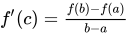
The mean value theorem generalizes Rolle's theorem. If a function is continuous on a closed interval and differentiable on its interior , then at some point in the interval the instantaneous rate of change equals the average rate of change over the whole interval. In symbols, if f is continuous on [a, b] and differentiable on (a, b), then there is a point c in (a, b) such that
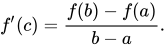
The theorem is often used to deduce information about a function from information about its derivative. For example, if a function has derivative zero throughout an interval, then the function is constant on that interval.
Taylor's theorem
[edit]Taylor's theorem gives a way to approximate a sufficiently differentiable function by a polynomial whose coefficients are determined by the values of the function and its derivatives at a point. The first-degree Taylor polynomial is the linear approximation to the function. Higher-degree Taylor polynomials give successively refined approximations. The theorem also gives a remainder term that measures the error in the approximation.
Taylor's theorem is the basis for Taylor series, which represent some functions as infinite series formed from their derivatives.
First and second derivative tests
[edit]The first derivative test uses the sign of the derivative to determine whether a critical point is a local maximum or local minimum. If a function changes from increasing to decreasing at a critical point, then the point is a local maximum. If it changes from decreasing to increasing, then the point is a local minimum. The derivative detects whether a differentiable function is increase or decreasing, and so examining its sign on either side of a critical point can determine whether the point is a local maximum, local minimum, or neither.
The second derivative test uses the second derivative. If f′(x) = 0 and f″(x) > 0, then f has a local minimum at x. If f″(x) < 0, then f has a local maximum at x. If f″(x) = 0, the test is inconclusive.
Applications of derivatives
[edit]Related rates
[edit]In many practical problems, several quantities depend on a common variable, often time. If the quantities are related by an equation, then the equation relating them can be differentiated to obtain a relation among their rates of change. Such problems are an application of the chain rule.
Optimization
[edit]One use of differential calculus is to find maxima and minima of functions. Fermat's theorem implies that an interior maximum or minimum of a differentiable function can occur only where the derivative is zero. These points, together with endpoints and points where the derivative is undefined, give the main (and typically the only) candidates for extrema, which can then be compared numerically to select the largest and smallest values to obtain the global extrema.
Further tests can often distinguish local maxima from local minima. The first derivative test uses the sign of the derivative on either side of a critical point, while the second derivative test uses the sign of the second derivative. These methods are used in curve sketching, elementary optimization problems, and mathematical modelling.
In several variables, analogous methods use the gradient and the Hessian matrix. A critical point of a scalar-valued function occurs where the gradient is zero, and the eigenvalues of the Hessian can often be used to classify the critical point as a local maximum, local minimum, or saddle point.
Calculus of variations
[edit]One example of an optimization problem is: Find the shortest curve between two points on a surface, assuming that the curve must also lie on the surface. If the surface is a plane, then the shortest curve is a line. But if the surface is, for example, egg-shaped, then the shortest path is not immediately clear. These paths are called geodesics, and one of the most fundamental problems in the calculus of variations is finding geodesics. Another example is: Find the smallest area surface filling in a closed curve in space. This surface is called a minimal surface and it, too, can be found using the calculus of variations.
Physics
[edit]Calculus is of vital importance in physics: many physical processes are described by equations involving derivatives, called differential equations. Physics is particularly concerned with the way quantities change and develop over time, and the concept of the time derivative — the rate of change over time — is essential for the precise definition of several important concepts. In particular, the time derivatives of an object's position are significant in Newtonian physics:
- velocity is the derivative (with respect to time) of an object's displacement (distance from the original position)
- acceleration is the derivative (with respect to time) of an object's velocity, that is, the second derivative (with respect to time) of an object's position.
For example, if an object's position on a line is given by

then the object's velocity is

and the object's acceleration is

which is constant.
Differential equations
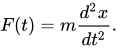
[edit]A differential equation is a relation between a collection of functions and their derivatives. An ordinary differential equation is a differential equation that relates functions of one variable to their derivatives with respect to that variable. A partial differential equation is a differential equation that relates functions of more than one variable to their partial derivatives. Differential equations arise naturally in the physical sciences, in mathematical modelling, and within mathematics itself. For example, Newton's second law, which describes the relationship between acceleration and force, can be stated as the ordinary differential equation
The heat equation in one space variable, which describes how heat diffuses through a straight rod, is the partial differential equation
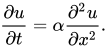
Here u(x,t) is the temperature of the rod at position x and time t and α is a constant that depends on how fast heat diffuses through the rod.
Implicit function theorem
[edit]Some natural geometric shapes, such as circles, cannot be drawn as the graph of a function. For instance, if f(x, y) = x2 + y2 − 1, then the circle is the set of all pairs (x, y) such that f(x, y) = 0. This set is called the zero set of f, and is not the same as the graph of f, which is a paraboloid. The implicit function theorem converts relations such as f(x, y) = 0 into functions. It states that if f is continuously differentiable, then around most points, the zero set of f looks like graphs of functions pasted together. The points where this is not true are determined by a condition on the derivative of f. The circle, for instance, can be pasted together from the graphs of the two functions ± √1 - x2. In a neighborhood of every point on the circle except (−1, 0) and (1, 0), one of these two functions has a graph that looks like the circle. (These two functions also happen to meet (−1, 0) and (1, 0), but this is not guaranteed by the implicit function theorem.)
The implicit function theorem is closely related to the inverse function theorem, which states when a function looks like graphs of invertible functions pasted together.
See also
[edit] Definitions from Wiktionary
 Media from Commons
 Quotations from Wikiquote
 Texts from Wikisource
 Textbooks from Wikibooks
 Resources from Wikiversity


- Differential (calculus)
- Numerical differentiation
- Techniques for differentiation
- List of calculus topics
- Notation for differentiation
 Mathematics portal

Notes
[edit]- ^ Newton began his work in 1665 and Leibniz began his in 1676. However, Leibniz published his first paper in 1684, predating Newton's publication in 1693. It is possible that Leibniz saw drafts of Newton's work in 1673 or 1676, or that Newton made use of Leibniz's work to refine his own. Both Newton and Leibniz claimed that the other plagiarized their respective works. This resulted in a bitter controversy between them over who first invented calculus, which shook the mathematical community in the early 18th century.
- ^ This was a monumental achievement, even though a restricted version had been proven previously by James Gregory (1638–1675), and some key examples can be found in the work of Pierre de Fermat (1601–1665).
References
[edit]Citations
[edit]- ^ "Definition of DIFFERENTIAL CALCULUS". www.merriam-webster.com. Retrieved 2020-05-09.
- ^ Alcock, Lara (2016). How to Think about Analysis. New York: Oxford University Press. pp. 155–157. ISBN 978-0-19-872353-0.
- ^ Weisstein, Eric W. "Derivative". mathworld.wolfram.com. Retrieved 2020-07-26.
- ^ See Euclid's Elements, The Archimedes Palimpsest and O'Connor, John J.; Robertson, Edmund F., "Apollonius of Perga", MacTutor History of Mathematics Archive, University of St Andrews
- ^ Ian G. Pearce. Bhaskaracharya II. Archived 2016-09-01 at the Wayback Machine
- ^ Broadbent, T. A. A.; Kline, M. (October 1968). "Reviewed work(s): The History of Ancient Indian Mathematics by C. N. Srinivasiengar". The Mathematical Gazette. 52 (381): 307–8. doi:10.2307/3614212. JSTOR 3614212. S2CID 176660647.
- ^ Berggren 1990, p. 307.
- ^ Berggren 1990, p. 308.
- ^ Berggren 1990, pp. 308–309.
- ^ Sabra, A I. (1981). Theories of Light: From Descartes to Newton. Cambridge University Press. p. 144. ISBN 978-0521284363.
- ^ Eves, H. (1990).
Works cited
[edit]- Berggren, J. L. (1990). "Innovation and Tradition in Sharaf al-Din al-Tusi's Muadalat". Journal of the American Oriental Society. 110 (2): 304–309. doi:10.2307/604533. JSTOR 604533.
Other sources
[edit]- J. Edwards (1892). Differential Calculus. London: MacMillan and Co. p. 1.
- Boman, Eugene, and Robert Rogers. Differential Calculus: From Practice to Theory. 2022, personal.psu.edu/ecb5/DiffCalc.pdf [1] Archived 2022-12-20 at the Wayback Machine.
| International | |
|---|---|
| National | |
| Other | |
